


For its debut in the fair’s main sector, New York gallery Ortuzar presents a focused selection of paintings and sculptures at Booth E15 spanning generations. The works share affinities of form, material, and feeling across periods and movements, placing historic works in genuine dialogue with contemporary ones. Anchoring the booth is a suite of early works by Suzanne Jackson, including a never-before-seen painting from the 1970s, alongside wall-mounted sculptures by Lynda Benglis ahead of her forthcoming retrospective at Kunstmuseum Basel. A dedicated section gives space to Claire Falkenstein’s latticed wire Sun and Fusion works, while figuration and abstraction runs through pieces by Maruja Mallo, Agnes Martin, and Takako Yamaguchi.
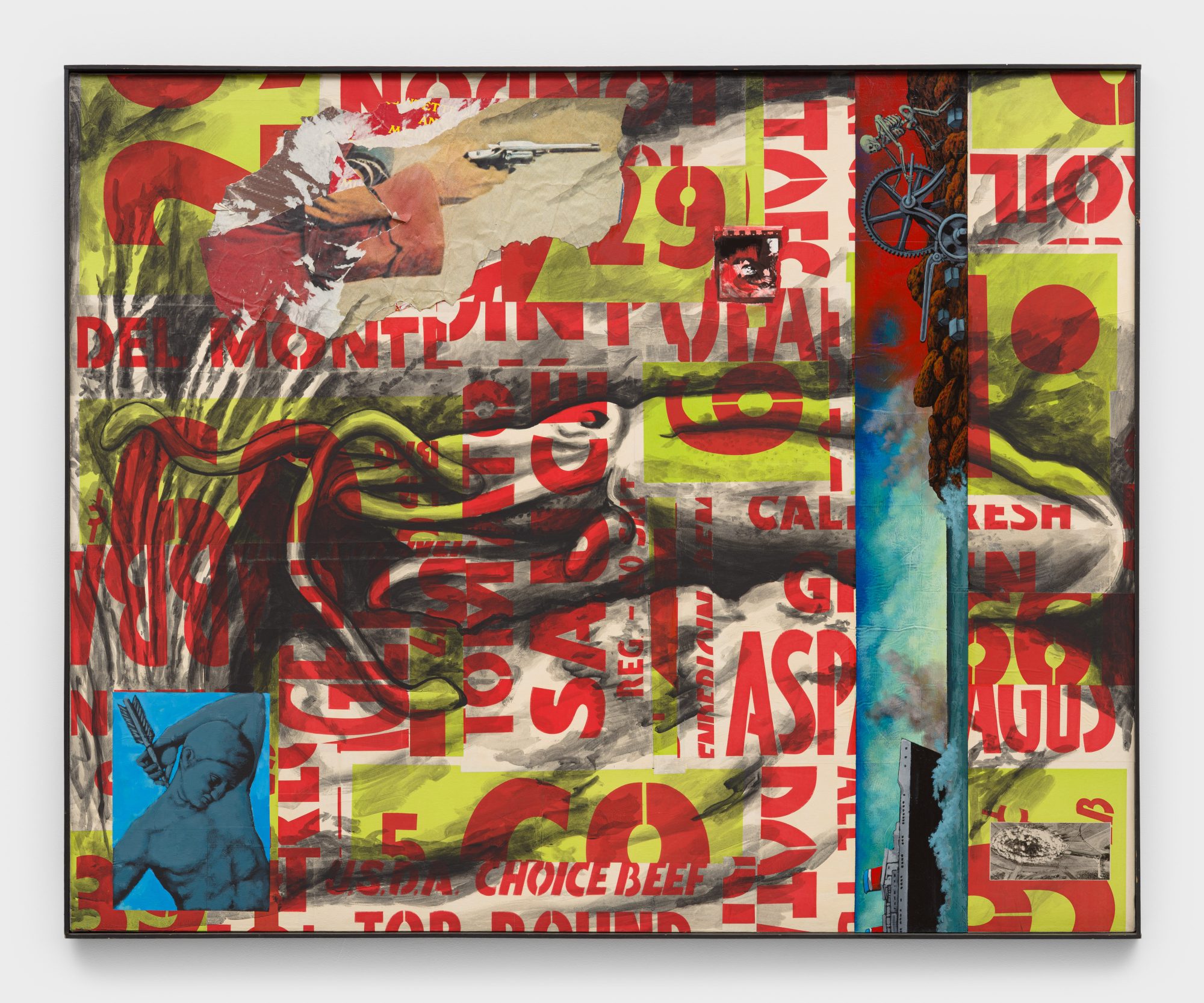
A few aisles over, P·P·O·W’s Booth B10 made its own case for cross-generational dialogue, anchored by David Wojnarowicz’s My Father Was a Sailor/My Father was the Century, 1988-89. The title performs a quiet slippage, collapsing father and era into a single unstable referent. Dominating the canvas is a squid rendered in ink, an unusual subject for an artist whose bestiary more often turned to whales; painted in a medium suited to its own creature, it takes on a translucent, spectral quality that dissolves into the collaged ground beneath it. Embedded within the composition is a solarized, inverted photograph of the artist as an infant in his father’s arms, the elder Wojnarowicz’s head reduced to a flash of white at the canvas’s upper right, the image’s distortion suggesting memory filtered through the same chemical violence that produced its ghostly negative. Painted at the height of the AIDS crisis, the piece reads less as nostalgia than as an interrogation of what gets passed down, and distorted, between generations.
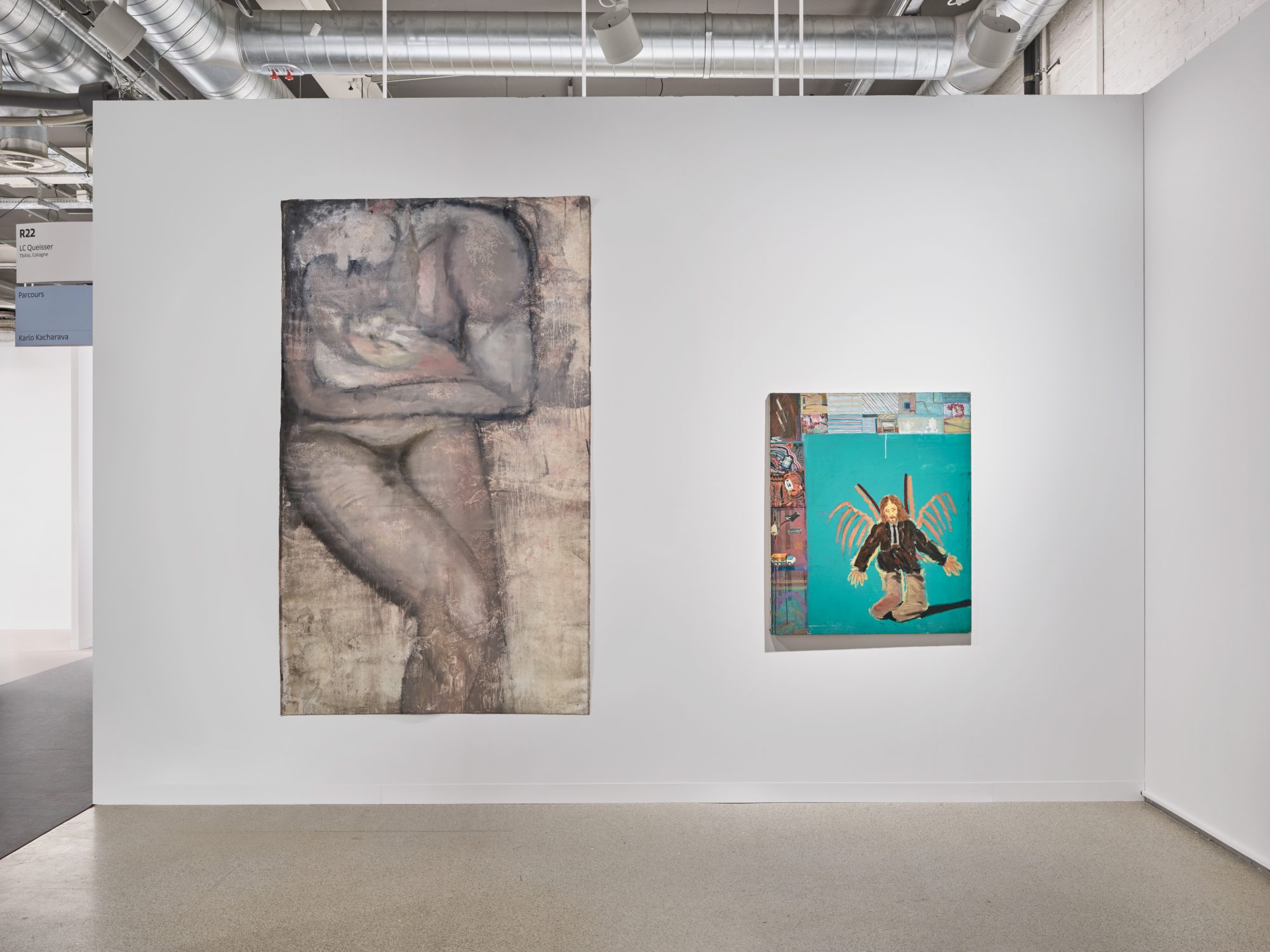
Photo: Choreo
At LC Queisser’s booth, a canvas by Ser Serpas held the wall with unusual force. Serpas built her early reputation on sculptural assemblage, gathering discarded furniture, mattress springs, and street detritus into precarious, often collapsing structures that read as bodies under duress without depicting a body at all. Untitled, 2026, a nearly eight-foot canvas, depicts a grey, robed figure folded into herself, arms wrapped tight across her own torso, the paint handling loose and unresolved at the edges in a way that recalls the provisional, half-assembled quality of her sculptures. Where her objects suggest bodies through absence, here the body appears directly, but still seems to be in the process of holding itself together rather than fully formed, a continuation of the same exhausted, self-protective posture that has defined her work in other media.
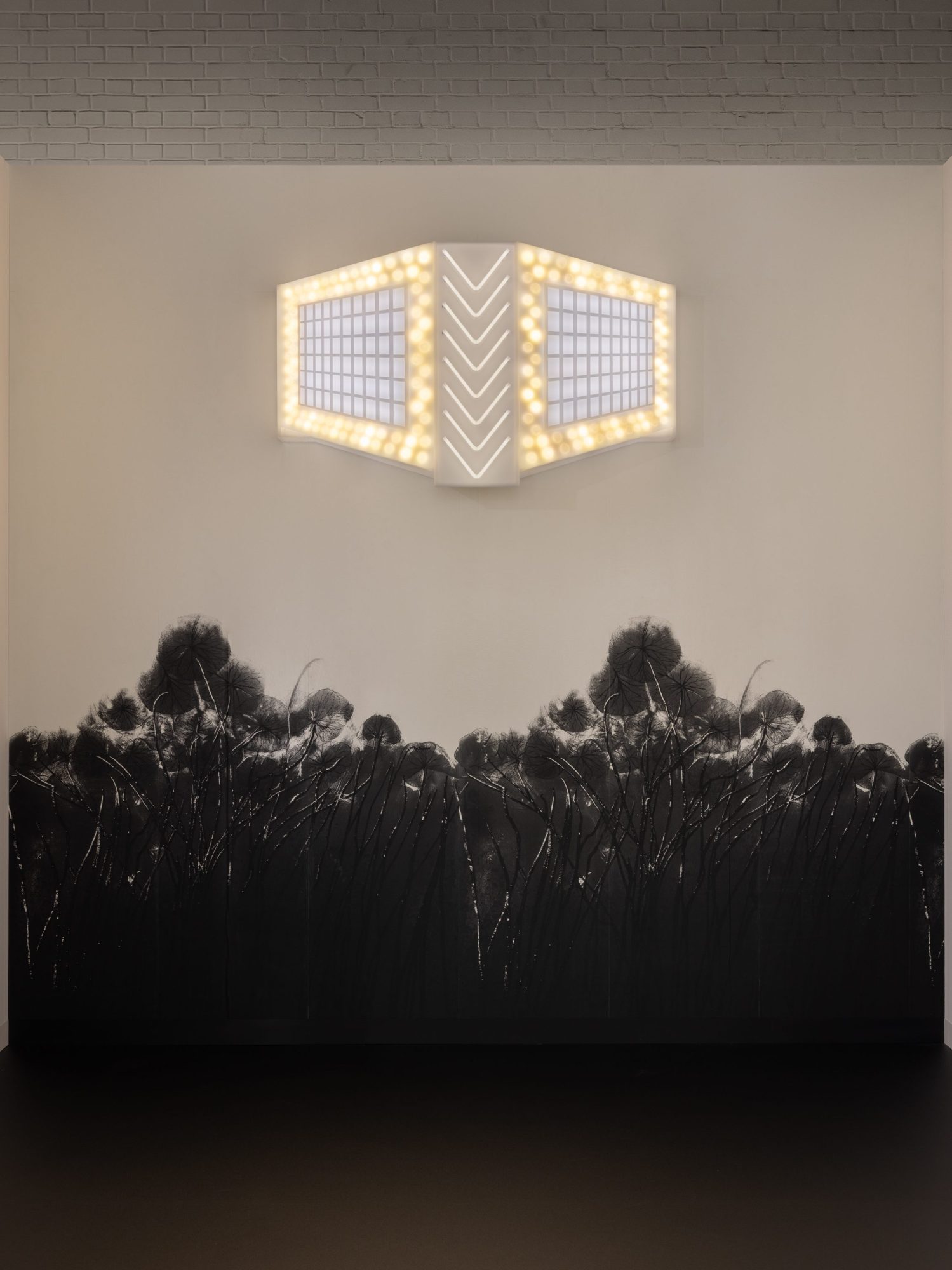
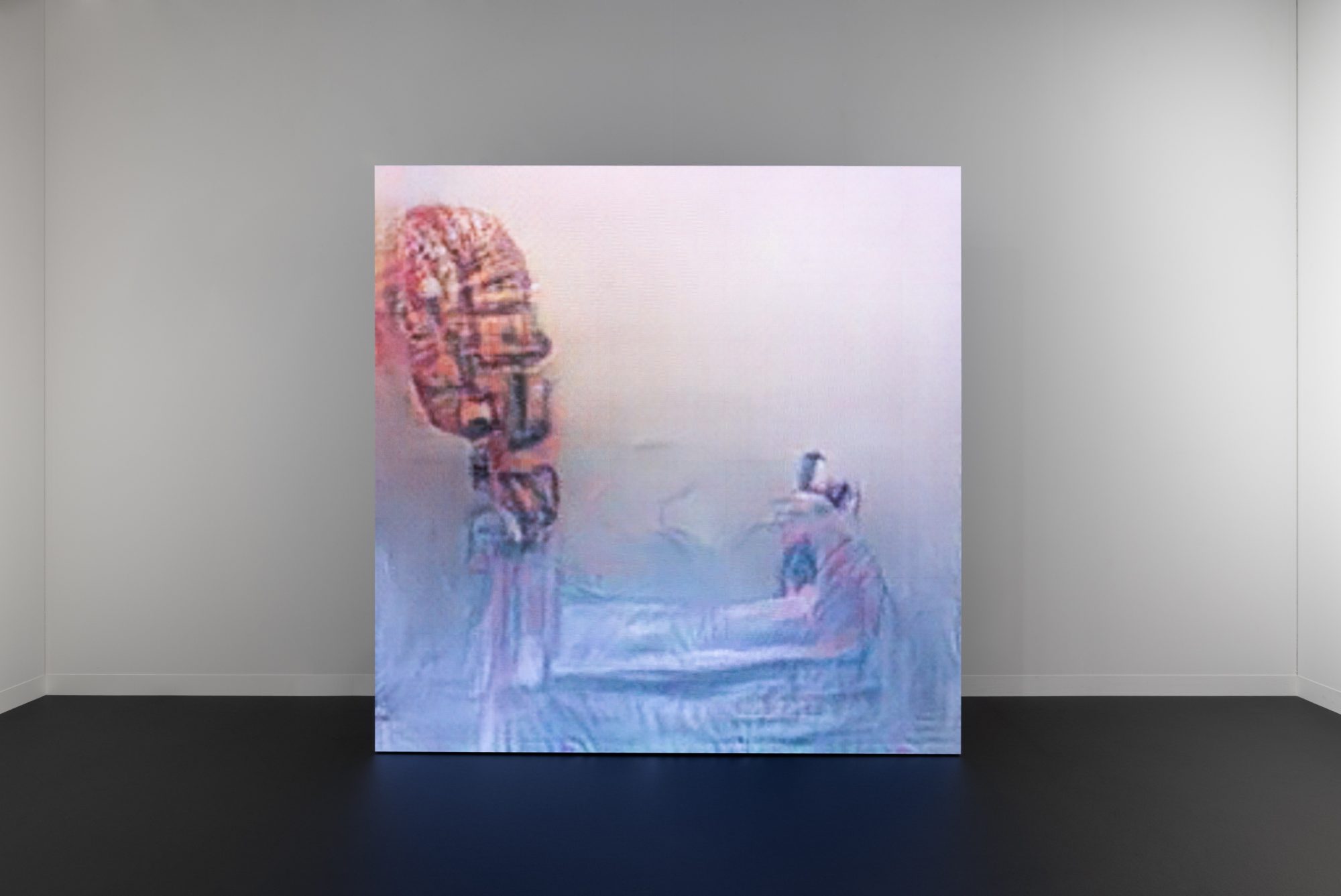
Esther Schipper’s booth took a sharply different register, centered on light, technology, and time. Philippe Parreno presented Chronochromes (Water Lilies) (2026), a phosphorescent wallpaper that glows and fades according to its own internal cycle. Referencing Monet’s Water Lilies, the work extends Parreno’s long-standing interest in duration and afterimages, transforming the image into a surface that continues emitting light after its source has disappeared. Nearby, Marquee (2026) reimagined a cinema sign in opalescent Plexiglas and neon, reflecting his ongoing focus on the structures of spectatorship rather than spectacle itself. Pierre Huyghe’s Of Ideal (2019-ongoing) pushed these concerns into more unsettling territory, using AI-driven image reconstruction to produce forms that continuously shift and reassemble in real time, treating the screen less as a window than a probabilistic organism.
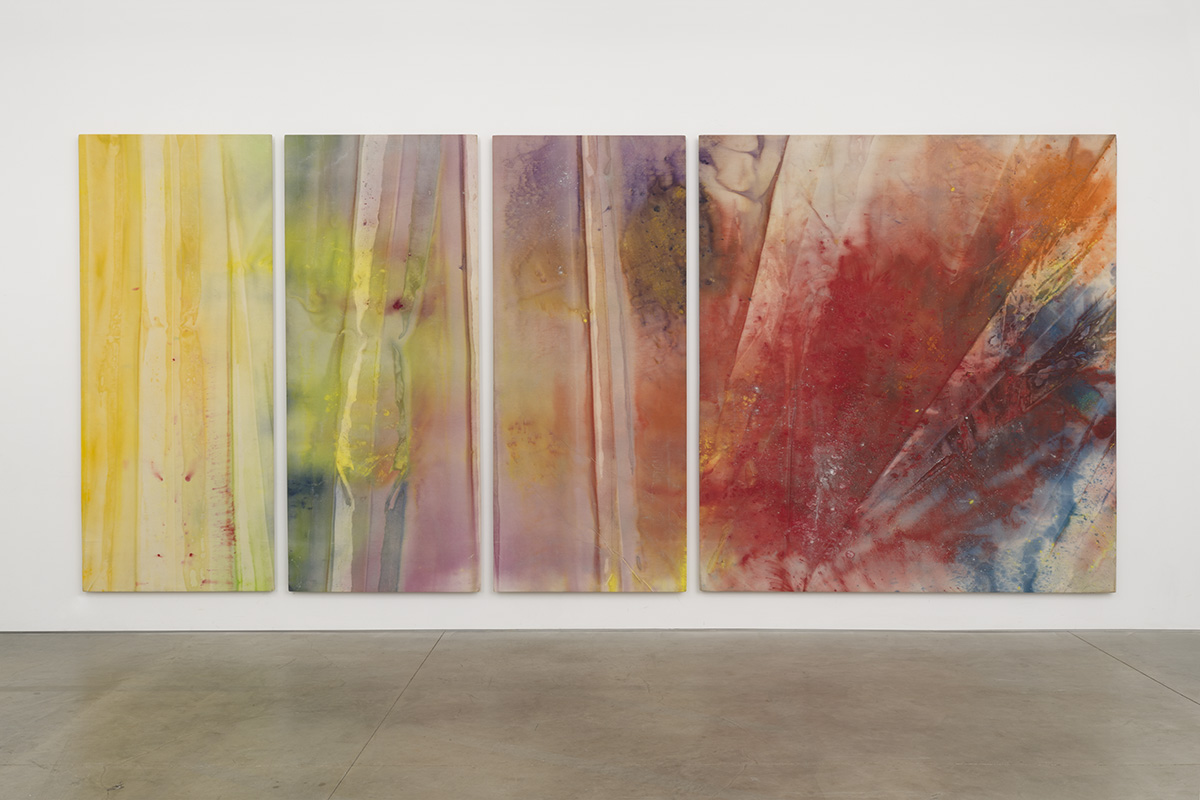
David Kordansky Gallery presented Sam Gilliam’s A Warmth, Lightness, A Glow and Then, 1968, from the breakthrough year in which Gilliam began removing the stretcher bar from his canvases entirely, staining and folding raw fabric so that it could drape, hang, or pool rather than remain taut. The move pushed his stain paintings beyond the conventions of the Washington Color School and toward something closer to sculpture, where gravity and chance became active collaborators in the work’s final form. This four-part composition, three panels of washed, vertical color giving way to a fourth, more densely worked field of red and blue, reads as a kind of internal argument between control and release, the controlled stain technique pushed toward its own undoing.
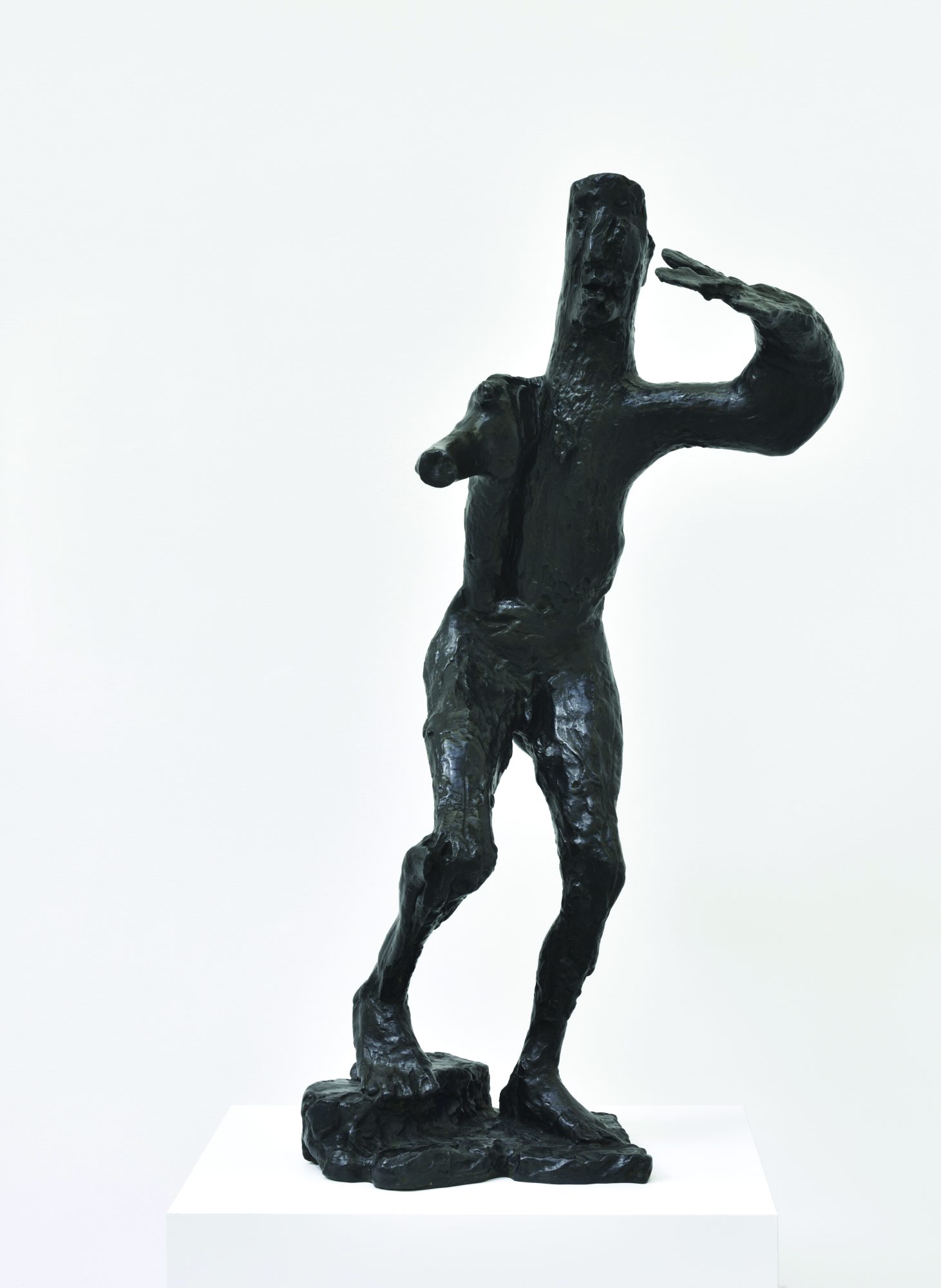
Paris gallery Galerie Christophe Gaillard brought one of the fair’s denser historical surveys, anchored by Germaine Richier’s patinated bronze L’homme-Forêt, grand, 1945-1946. Made in the immediate aftermath of the war, the work belongs to Richier’s broader project of fusing the human figure with corroded, arboreal, and insect-like forms, a body eaten away rather than idealized. Where her contemporary Giacometti was reducing the figure to an attenuated line, Richier instead roughened and pitted the surface, treating bronze as though it had been left outside to weather for decades. The Homme-Forêt pose, rooted and upright like a tree trunk yet unmistakably human in its stance, suggests a body absorbed back into nature rather than standing apart from it, a fitting image for a moment when postwar Europe was reckoning with what remained of the human form after catastrophe.
Across the fair, the throughline was less a single theme than a willingness to let history speak back to the present, whether through decades-old works placed in new contexts or younger artists working in direct conversation with the figures who came before them.
by Daisy Wu
Images courtesy of the respective galleries and photographers.
Pages: 1 2