Currently showing at the National Museum of Decorative Arts in Buenos Aires, Argentia, is an exhibition of works by German artist Gerhard Richter. The exhibit is titled Synopsis, and it includes a variety of works that span four decades. Richter is well-known for his photo-paintings and abstract pieces, both of which are on display. The title Synopsis is fitting; the museum called the exhibit “retrospective” and therefore indicative of Richter’s growth over the years.
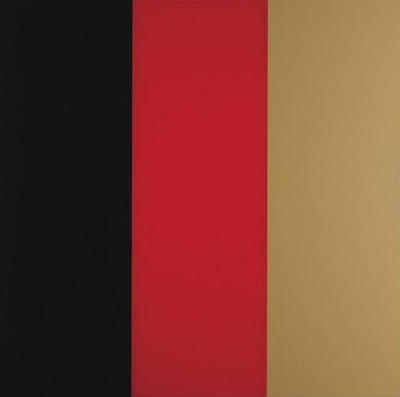
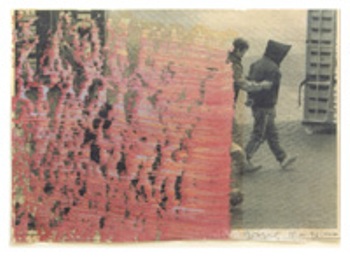
Much of Richter’s work at the exhibit is political. October 18, 1977 [1988] is a series of photographs that depict the final moments of members of the German Red Army Faction, a left-wing group whose members purportedly committed suicide while in prison. Richter has said that these photographs record life “as it is.” His journalistic style in reporting these events shows that he values art not only or its aesthetic appeal, but also for its ability to document the past. Richter’s political influences extend to his nationality. Black, Red, Gold (1999) rests in the German parliament, and it is a slightly faded glass version of the official German flag.
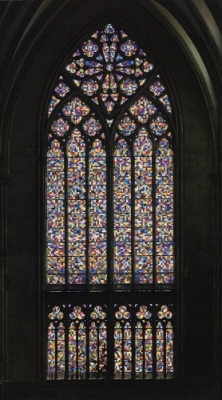
Richter is well-known for his photo-paintings, works that are made using paint but based on photographs. One at the exhibit is Domecke Р[Cathedral Corner] (1998). It is simultaneously detailed and unfocused; a white chunk of the building is almost too much, but it is balanced by a tree to one side and a brown brick fa̤ade on the other. It is a depiction that has seen three stages Рit is adapted from the painting Cathedral Corner, which is a work that is based on another photograph taken by Richter at the Cologne Cathedral. In the past, Richter has had other ties to the cathedral; in August 2007, he revealed a stained glass window comprised of thousands of small pieces of glass. The piece is popular, despite criticism from some higher-ups in the Church.
Born in 1932, Richter is known for his photo-paintings and abstract work. He reportedly began working with photographs so that he could “escape the complicated process of deciding what to paint.” His work has been featured internationally.
– O. Loving
Gaily ever after: is gay marriage the new civil rights struggle or has it co-opted a legacy?(Cover)
Colorlines Magazine September 22, 2004 | Hernandez, Daisy That night, the room was packed at the gay community center in New York’s Greenwich Village. Surely something had to be done. Bush had announced his support for a proposed federal amendment that would effectively ban gay marriage.
[ILLUSTRATION OMITTED] So, there was talk of strategies. There were speeches about history and one’s place in time. There was mention of Rosa Parks.
It was that last part which didn’t sit well with Sylvia Samuels and Diane Gallagher as they surveyed the speakers. “My reaction was, ‘Where do these people stand on other issues that relate to black people?'” recalled Samuels, a black lesbian.
Gallagher, who is white, remembered looking at the other faces in the crowd and onstage. “It made me have this visceral reaction,” she said, “because I’m not sure these people would have been active in the civil rights movement.” The two women had been part of the civil rights and antiwar protest movements in the late 1960s and ’70s. An interracial couple, they know homophobia and racism well. They also know love. They met 24 years ago in Greenwich Village and raised two girls. Photographs show them now in their 50s, still smiling, one’s hair wavy, the other’s locks cut short. They are doting grandmothers–and suing the state of New York for the right to marry.
Their desire to wed, and likewise their criticisms, embody the question that has been bandied about since Massachusetts legalized same sex marriage last November: Is gay marriage the next civil rights struggle? Or, is it the co-opting of a movement?
Polls have found mixed reactions to gay marriage among people of color. Last year, the Pew Research Center found that 60 percent of blacks and whites opposed gay marriage, but a New York Times poll reported black opposition at 75 percent. In New Jersey, where a lawsuit to legalize gay marriage is pending, polls found 31 percent of Latinos opposed gay marriage compared to 53 percent of blacks and 55 percent of Asians.
Few polls, if any, however, have queried lesbian, gay, bisexual and transgender (LGBT) people of color. In fact, writing about gay marriage brings to mind the book, All the Women Are White, All the Blacks Are Men, But Some of Us Are Brave. A treatise on gay marriage could be titled “All the Gays Are White, All the Ministers are Black, But No One Asked the Rest of Us.” Interviews with more than a dozen LGBT people of color–from a couple now legally married with children in Massachusetts to a college graduate who identifies herself as a “conscientious objector to the status quo”–suggest a mixed reaction to the fight for gay marriage. Unsurprisingly, the right to marry has wide support among LGBT of color. But the comparison to the civil rights movement has bred hostility where it was meant to sow solidarity, and what the impact of gay marriage will be for LGBT of color is the real subject of debate. this web site gay marriage facts
Comparing the “Single Trait” Ministers might be riled up about sins of the flesh, but the debate around gay marriage has a real racial edge. As the first gay wedding preparations were underway in Massachusetts in May, the state’s governor, Mitt Romney, told city clerks they could enact a 1913 law barring out-of-state couples from marrying if their home states wouldn’t recognize the marriage. The law was originally intended to bar interracial couplings. Another, perhaps cruder, homage to the past was paid by Gregory Daniels, a Chicago black minister, who said he would “ride” with the KKK if they were against gay marriage.
In Goodridge v. Department of Public Health, the case that legalized gay marriage in Massachusetts, the state’s Supreme Judicial Court justices wrote that “for decades, indeed centuries, in much of this country … no lawful marriage was possible between white and black Americans.” They referenced Perez v. Sharp and Loving v. Virginia, historic cases that legalized interracial marriage and then compared those cases to gay marriage, citing the difference as “a single trait: skin color in Perez and Loving, sexual orientation here.” But this formula of “gay = black” has upset some LGBT of color.
“We don’t need to sing, ‘We shall overcome.’ We don’t need to draw equal signs between those two movements,” said Imani Henry, a New York activist and black female-to-male transsexual. “That’s the beauty of solidarity. We don’t have to face the same fight to work together.” The equating of race to sexual orientation comes as gayness is being popularized with TV shows and increasingly associated with whiteness. In the ’90s, many LGBT of all colors claim, the gay movement went mainstream and became the mouthpiece for wealthy white gay men. Now, they say, it has lost touch with what many, perhaps nostalgically, remember as its more radical origins. And if the comparison of gay marriage to the civil rights movement has raised ire, many LGBT of color say it’s because it doesn’t take into account the racial and often economic privileges white gays have.
“These people, if they were straight, they’d be in the upper class. [Marriage] that’s like their last hurdle,” said Chan-I Min, 25, of Washington, D.C. She’s Korean, bisexual, pierced and a self-described “conscientious objector to the status quo.” She added, “People like myself, we were never meant to be at the table.” Samuels thinks that many white gays, in not being able to marry, are feeling discrimination for the first time. “As a black person you live in this country and that’s everyday,” she said. “Someone doesn’t like you because you’re black. Someone doesn’t serve you because you’re black. That’s every day life. But if that’s the first time this is happening to you, you’re going to have a different kind of reaction, and not understand that, hey, a lot of people are discriminated against and this is the first time for you–but it’s not for other people.” Many LGBT of color are equally frustrated with black ministers who have depicted sit-ins in the South as the sole work of black heterosexuals. It’s an assertion that infuriates Jon Everett, interim director of BlackOut Unlimited, a gay black social service organization in Cleveland, Ohio.
“The civil rights movement was monumental, and a lot of those people were gay and lesbian. To say ‘this is mine!’ is crazy,” said Everett. He takes a breath and chuckling adds, “There were some black gay slaves, too.” Ironically, comparing gay marriage to feminism might have been a better fit. But because the civil rights movement resonates with moral authority, it has everyone grabbing at its coattails. Such clutching to the past has suggested that racism ended with the legal decisions of the ’50s. The Brown decision has been drawn on for comparisons, especially as its commemoration fell on May 17, when gay marriage became legal in Massachusetts, but few commentators on gay marriage talked about why schools today remain racially segregated.
Sex and Race, Another Wedge Issue?
Earthlyn Manuel is not one to follow the crowd, let alone march up the altar just because the rest of the city is doing just that. So the 51-year-old writer declined to leave her home in Oakland, cross the bay and get married when the mayor of San Francisco began issuing licenses to same-sex couples. Her partner of four years, Simbwala Schultz, a therapist–though a bit more inclined to wed-lock (“Once I’m in the relationship, I’m married”)–agreed they should wait until they were ready.
[ILLUSTRATION OMITTED] Asked why she thought so many of the gay couples saying “I do” were white, Manuel, who is out to her family, said she felt people of color couldn’t risk so easily the approval of their families and communities.
“When we get married, we want everyone there–the neighborhood, the church,” she said, spreading her arms, and then dropping them, added, “Sometimes the fear of that not happening scares me.” The two women, black lesbians, live on a tree-lined street in a black neighborhood, and it’s on streets like these where opponents to gay marriage have argued (and its supporters fear) that the issue is dividing communities of color. “If the education isn’t happening in our communities, it will indeed become a wedge issue,” Melendez Rivera said. “Poll after poll after poll shows that the less people know, the more likely they are to be afraid.” In San Francisco, Debbie, who asked that her last name not be used, watched the gay newlyweds go by in San Francisco. She was not ready to marry her girlfriend, but if she had been, she wouldn’t have gone before the cameras. The American-born daughter of Chinese parents, she is not out to her family.
“The history of gayness has been seen as a white thing,” she said, “so immigrants often see it as an American thing–not as part of my culture.” Those perceptions were exploited in March, when Ruben Diaz, a New York state senator and Democrat, known for his advocacy on immigration and police brutality issues, organized an anti-gay marriage rally in the Bronx. go to web site gay marriage facts
“Right now I don’t think an ad on gay marriage would play really well in the Latino community,” said Andres Duque, director of Mano a Mano, a network of Latino LGBT organizations in New York.
Mano a Mano plans to run ads in local Spanish-language newspapers this fall that place gay people in the context of familia. Ads will, for example, feature an uncle saying, “This is my nephew. He’s gay, and I’m proud of him.” Other groups have taken a different approach. A rally in Boston on May 17 linked the marrying of same sex couples to the commemoration of the Brown decision. Imani Henry, who spoke at the rally, said that the International Action Center, the organization he works with, also placed the issue in the larger context of the detention of Muslim and Arab immigrants since Sept. 11.
“We are not asking for people to show solidarity with the right to marriage,” Henry said. “We’re asking people to show solidarity with every fight.” In Washington, D.C., leading Latino organizations including the National Council of La Raza announced in May their opposition to the proposed federal amendment banning gay marriage. It wasn’t a ringing endorsement of legalizing same sex marriage, but an opposition to writing discrimination into the Constitution. Increasingly, gay marriage has received such mixed blessings from communities of color. Julian Bond has publicly voiced support of gay marriage even as the NAACP, of which Bond is chairman of the board of directors, has only denounced the proposed amendment as of this writing.
“There really hasn’t been a dialogue at the NAACP or the Urban League about the discrimination against gay and lesbians,” said H. Alexander Robinson, strategic director for the National Black Justice Coalition, a new group of black LGBT that formed to respond to the gay marriage debate.
The group has looked at the voting records of lawmakers who want to ban gay marriage. There is a consistent pattern of voting against issues that matter to communities of color among these legislators, Robinson said. Marilyn Musgrave, a leading advocate of the amendment to ban gay marriage, voted to reauthorize welfare reform that included a proposal to increase the work requirements for single moms to 40 hours a week.
What’s Marriage Got to Do With It?
According to the U.S. General Accounting Office, married couples receive about 1,049 federal benefits. But some LGBT of color have suggested that gay marriage will just put queers in the same shoes as their heterosexual counterparts: dependent on marriage to access benefits like health care.
“We’re no longer holding the state responsible for those economic and social and political rights that should be basic for all,” said Joo-Hyun Kang, former director of the Audre Lorde Project, a Brooklyn organization for LGBT of color. As queers of color, she added, “We’re also the ones who often have the least access to jobs with things like health care.” Neither Manuel or Schultz have health care coverage. “That’s why when you say marriage, I’m like huh?” Manuel said. “We’re just trying to survive.” Couples like them worry about access to schooling or renting an apartment, and marriage, that ever-shifting terrain of love forever, butterflies in your stomach, and property ownership, can feel frivolous.
“We’ve done nothing to talk about my right to walk down the street. Gay marriage does none of that,” said Kenyon Farrow of New Orleans. A gay black man, he’s the regional coordinator for Critical Resistance, an organization working to abolish the prison industrial complex. Farrow argued that black people should be organizing to make their communities safer for gays, “so that no matter whether I have a ring, I can walk down the street.” Some of the resistance to making gay marriage a priority for LGBT of color, though, sounds vaguely like, “I’ll get married when the revolution comes,” even while marriage could offer immediate temporary relief. A Boston Globe survey of gay couples who married on May 17 found that two-thirds were women. According to Gary Gates, co-author of The Gay & Lesbian Atlas (Urban Institute Press, 2004), 53% of lesbian couples, where one or both are women of color, report having children. If marriage were approved at the federal level, these women would have access to increased pensions and social security, as well as compensation if their spouse died in a work-related accident.
Of course, legalizing marriage would mean other benefits, the kind that can’t be tallied.
Vivian Dalila Carlo and Lillian Gonzalez, both Puerto Rican, have shared a life for 25 years. A teacher and an accountant, they are now raising a son, 11, and daughter, 8, in Boston. They were married on May 17 in Brookline, Massachusettes. But homophobia, inscribed in laws, means they take a risk whenever they visit Florida, where Gonzalez’s mother lives. If something happened to her wife, Carlo said, “the sheriff could come and take my kids, and I couldn’t do anything about it.” Legalizing gay marriage at the federal level would protect them. That’s also how it looks to Samuels and Gallagher, one of the 13 couples that the American Civil Liberties Union is representing against the state of New York. The lawsuit, filed on April 7, is making its way through the courts.
In the meantime, Samuels is recovering from severe burns she suffered in a fire last year and also undergoing a number of tests to see if a tumor in her liver is cancerous or benign. She and Gallagher, who live in Mt. Vernon, New York, are fortunate enough that Gallagher teaches in the Bronx and that the New York City Board of Education grants health insurance to domestic partners.
“We would have lost the house to the bills,” said Gallagher. “If they didn’t have domestic partnership, we would have been devastated.” Carlo is adamant that she doesn’t want her right to marry to put anyone else at a disadvantage. “I don’t think we should be forced into marriage if we want rights–anymore than we should be denied the right to marry,” she said.
Despite the debate, for Carlo, gay marriage is very much a civil rights issue.
“Discrimination in any form is discrimination,” she said. “Limiting people’s rights to access of whatever it is, whether it’s ownership of property, of the water fountain you drink at, the ability to get married–to limit a group of people for something about themselves that they cannot change is discrimination.” Daisy Hernandez is a senior editor at ColorLines. She plans to get married, too–as soon as her girlfriend asks–and hopes their old-school Colombian and Mexican mothers will attend.
Hernandez, Daisy