Global contemporary art events and news observed from New York City. Suggestion? Email us.

The New York Times Profiles Green Gallery Founder Richard Bellamy

Tuesday, July 26th, 2016

The New York Times has a profile on Richard Bellamy this week, the founder of New York’s influential Green Gallery, and the dealer who first provided space and a voice for many of New York’s influential minimalists, including Donald Judd, Robert Morris, and many more.  “I think,” Robert Morris says of Bellamy’s impact on this group,  “it had to do with the fact that we — the artists and Bellamy himself, who we regarded as more of an artist than a ‘director’ — were sitting in a space on 57th Street, when we all belonged downtown in our ratty lofts. There was something slightly ridiculous about occupying that zone where the serious, moneyed New York galleries were located.” (more…)

Go See – New York: Dan Flavin at Paula Cooper Gallery through October 30, 2010

Friday, September 17th, 2010


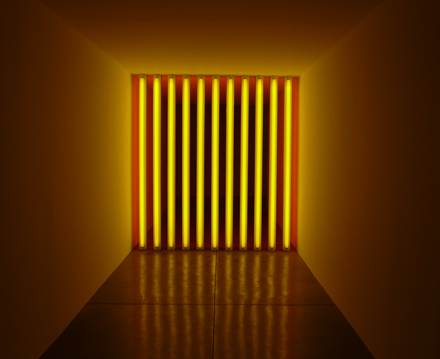
Dan Flavin, untitled (to Barry, Mike, Chuck and Leonard), 1972-1975. All images by Art Observed.

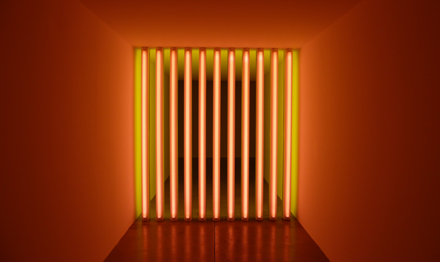
The current exhibition of early works by Dan Flavin at Paula Cooper Gallery offers a concise exploration into the artist’s experiments with the effect of colored light on architectural space. A 1960s minimalist, Flavin’s works realize the infinite possibilities inherent in the simple gesture of a florescent light in a gallery, which, despite a limited vocabulary, create varied optical and experiential situations. Flavin’s works confound the way that art is viewed by testing the limitations of opticality while stressing color as a medium in its own right. Instead of the viewer looking at a two dimensional object with painted colors, Flavin brings the color to the viewer, aggressively inserting his color combinations into the viewer’s eyes. That is, instead of the art reflecting color, it is emitting the color as light. If the purpose of art is to look, to see, to contemplate a visual object, then Flavin’s art frustrates this standard notion by making it difficult to look directly at the art object itself. This difficulty of viewing the art object directly causes the viewer to notice the effect of light and color on objects, thereby implicating the architectural space within the work. The works thereby occupy every part of the room, using the unusable spaces of a gallery–the corners and the floors, spaces incapable of displaying artworks.


Dan Flavin, untitled (to Barry, Mike, Chuck and Leonard), 1972-1975.

More text and images after the jump…

(more…)

Go See: Dan Flavin at Zwirner & Wirth, New York, March 6-May 3

Sunday, March 9th, 2008


The nominal three (to William of Ockham), 1963 [telegraph uk]

Zwirner & Wirth is re-staging a seminal exhibition of Dan Flavin’s fluorescent light sculptures which first took place in 1964 at Green Gallery in New York. The show marked the first time his work was entirely composed of fluorescent lights– a practice which would characterize him for the rest of his career, making him commonly regarded as one of the most influential artists of the late 20th century.

Exhibition information [Zwirner and Wirth]
Biography of Dan Flavin [NGA]
More [The New York Times]

(more…)