

Born in Kent in 1934, Wylie studied at Folkestone and Dover Art School, then later at the Royal College of Art, before stepping away from painting for two decades to raise her children, breaking through in 2010, aged 76.
I put a series of questions to Wylie, whose responses balance instinct with a precise knowledge of her practice, and a keen sensitivity to how her work is received.
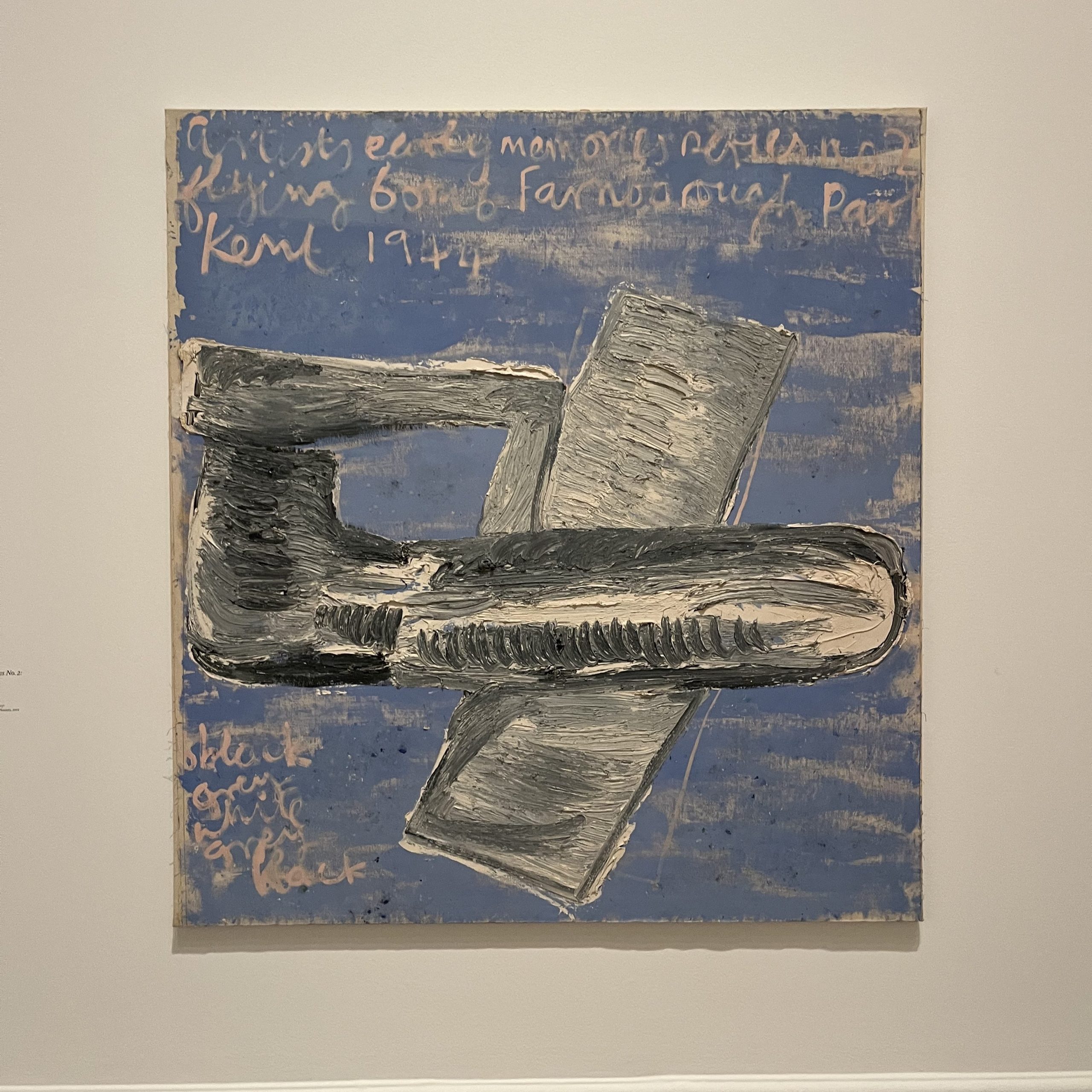
The exhibition is arranged thematically, opening with Wylie’s early memories of Kent and wartime London. In this era, she often returns to the image of the “doodlebug,” the infamous German bomb named for its engine’s buzzing sound, as a defining characteristic. It appears looming over scenes otherwise quite serene, a sentiment to her early childhood experience. From there, she expands to pop culture, film, football, and biblical references. Seen together, the works suggest what Wylie describes as “mostly an organic progression,” with “shifts of emphasis, or handling,” rather than any fixed narrative.
Upon entering the gallery, visitors receive Rose Wylie’s A–Z, a small booklet written to accompany her 2025 exhibition, Flick and Float at the Zentrum Paul Klee, Bern. It offers an index of terms that matter to her practice: I for “Instinct,” E for “Emotion,” though they’re “not her thing,” and J for “Joy”. As in her paintings, depth is carried jauntily—her exacting playfulness shines through here.
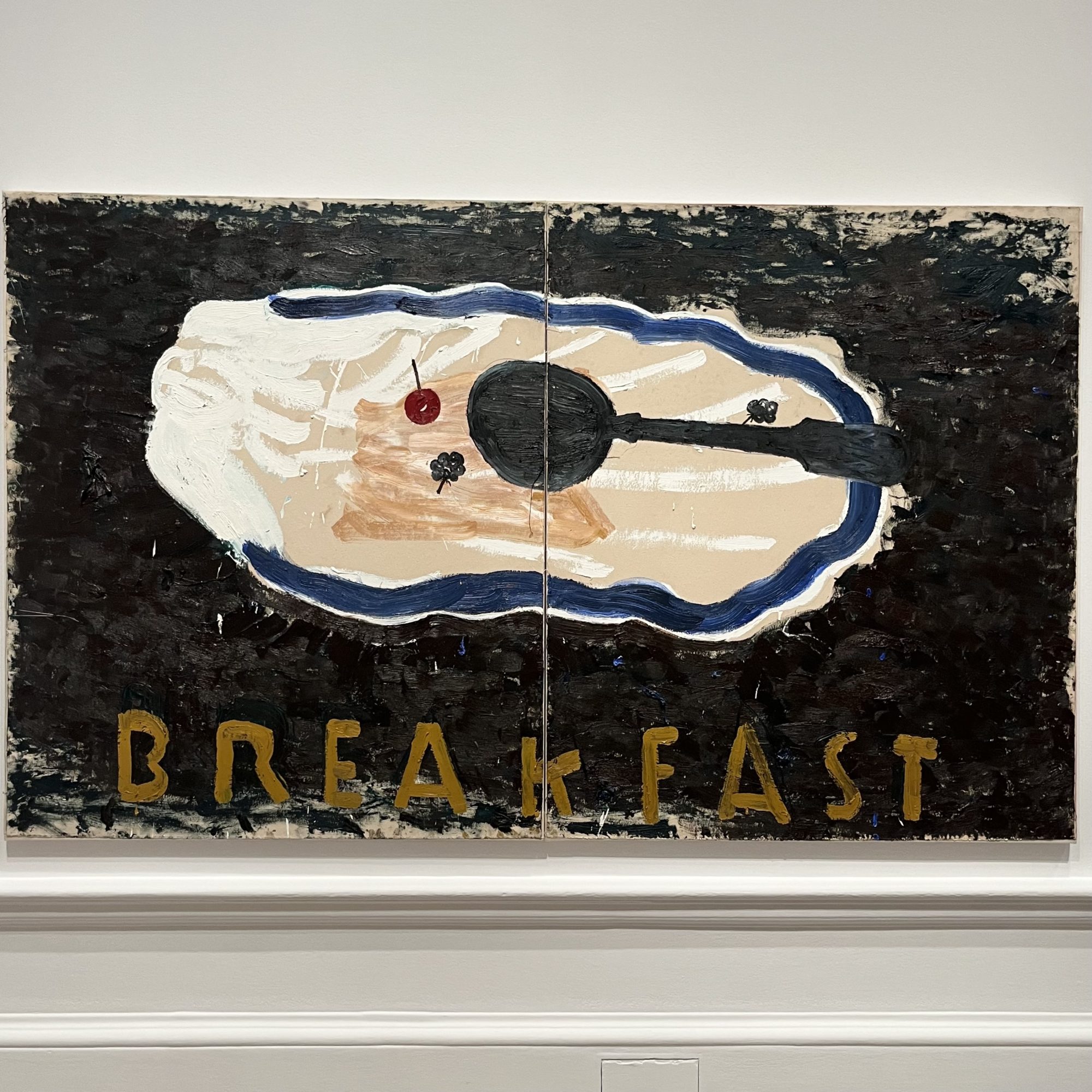
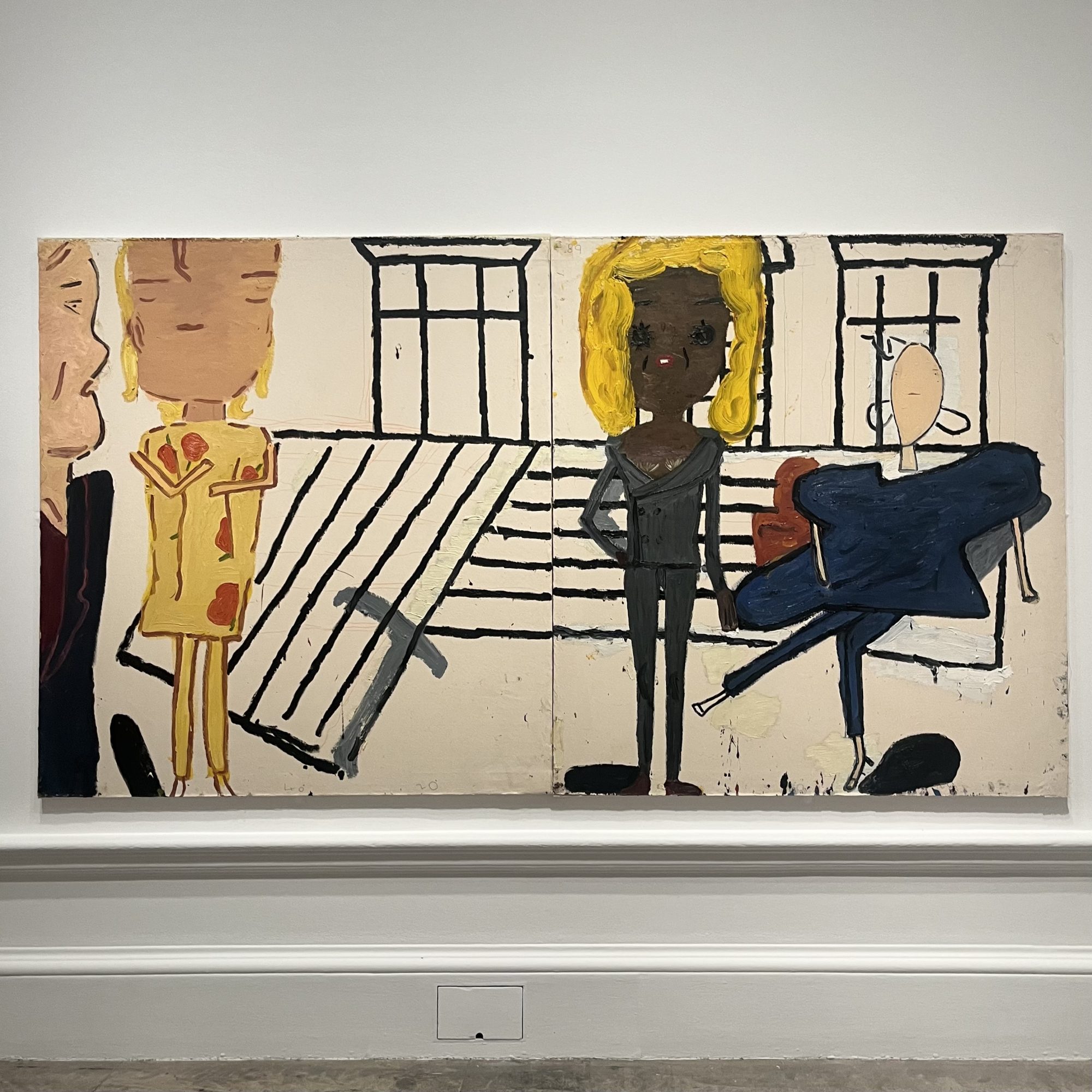
Wylie is present, but never hurried. Inspiration is allowed to unfold, operating somewhere between patience and decisiveness: “When I see something exciting, and would like, somehow, to keep it, I pick up a pencil.” For her, subjects are encountered, not refined. “You can’t manufacture a subject. It would feel forced.” This logic is evident across the works on view. In Breakfast (2020), the composition appears to settle around a loose blue squiggle in the china, as if the painting has organised itself around a detail. Similarly, PV Windows and Floorboards (2014), which won her the John Moores Prize in 2014, begins from a simple observation: three women she found visually striking. That “subjects suddenly turn up, or not,” creates an endearing spontaneity in her style that feels refreshing and incredibly bright.
This instinct extends to her handling of paint. Often working directly with her hands, she describes its physical immediacy—“the paint feels cold in winter”; this direct approach blossoms without an intermediate. Forms are not outlined and filled in, but pushed outward from within, requiring what she calls a “generous” subject, one where detail is superfluous. In Red Painting: Bird, Lemur, & Elephant (2016), forms are broad and generous, edged by smears that register as traces of movement, as if the painter’s involvement remains visible on the surface. The result is a directness that avoids refinement, yet loses nothing in legibility, complexity, and style.
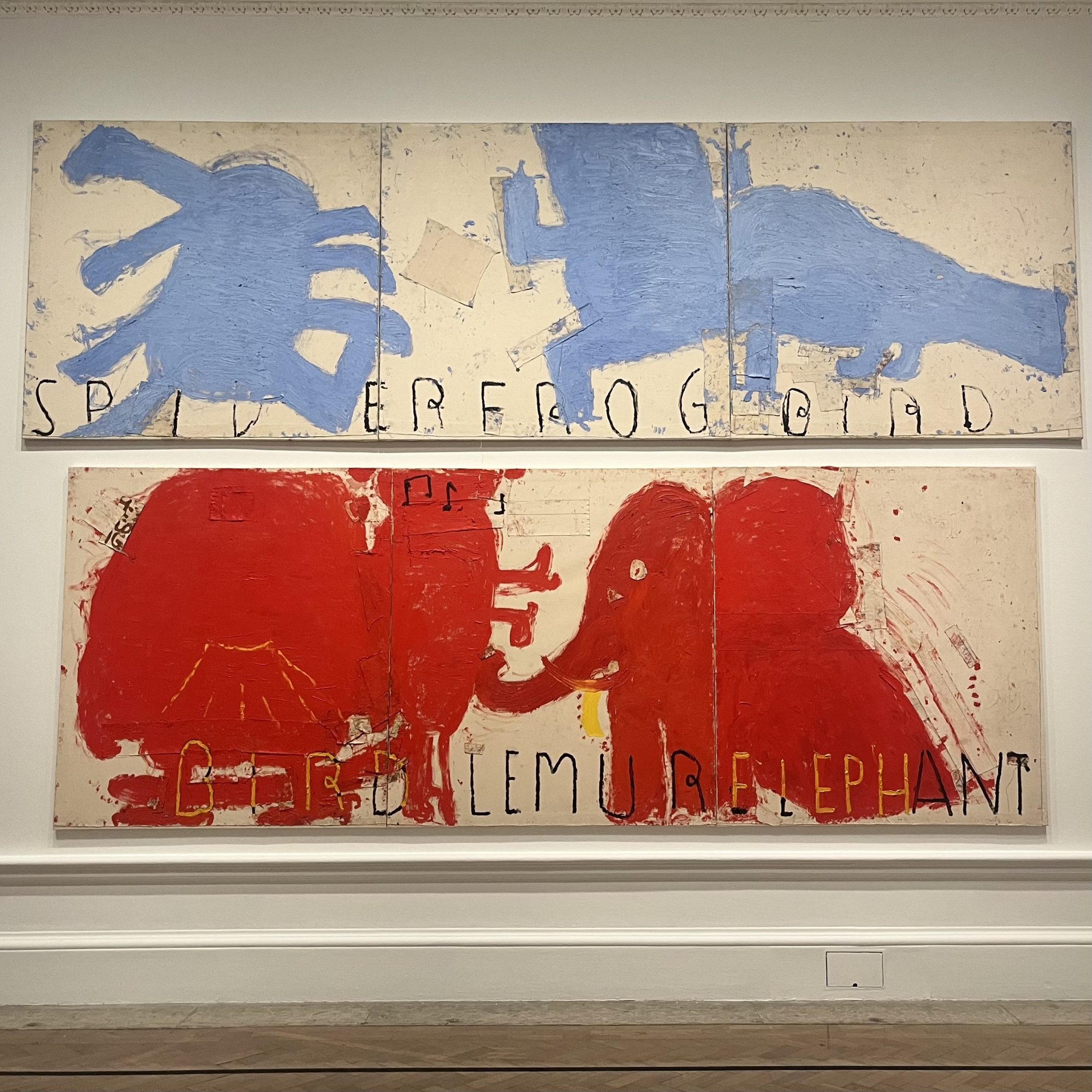
and Red Painting: Bird, Lemur & Elephant (2016)
Wylie is highly attuned to how her work is received, noting that paintings she considers among her favourites—Brunhilde (Film Notes), 2024 in this case—are often overlooked by critics and the Instagram public. “Is it the subject that governs this, or the colour?” she questions. For her, it’s ambiguous. Subject, she argues, is merely an “attribute”; it is far more about “how a painting IS.” She references the work of Giovanni di Paolo, The Beheading of Saint John the Baptist, to speak for this; however dark, the painting is still “brilliantly treated.” Even aesthetics is a loose explanation; brown, she notes, is not very popular. But, the painting is not simply brown; the colour is “changed from place to place… a case of subtle, or close, modulation.” She instead points to a deeper divide between what a painting demands and what an audience is inclined to see, acknowledging that darker subject matter may deter viewers before its treatment is fully viewed.
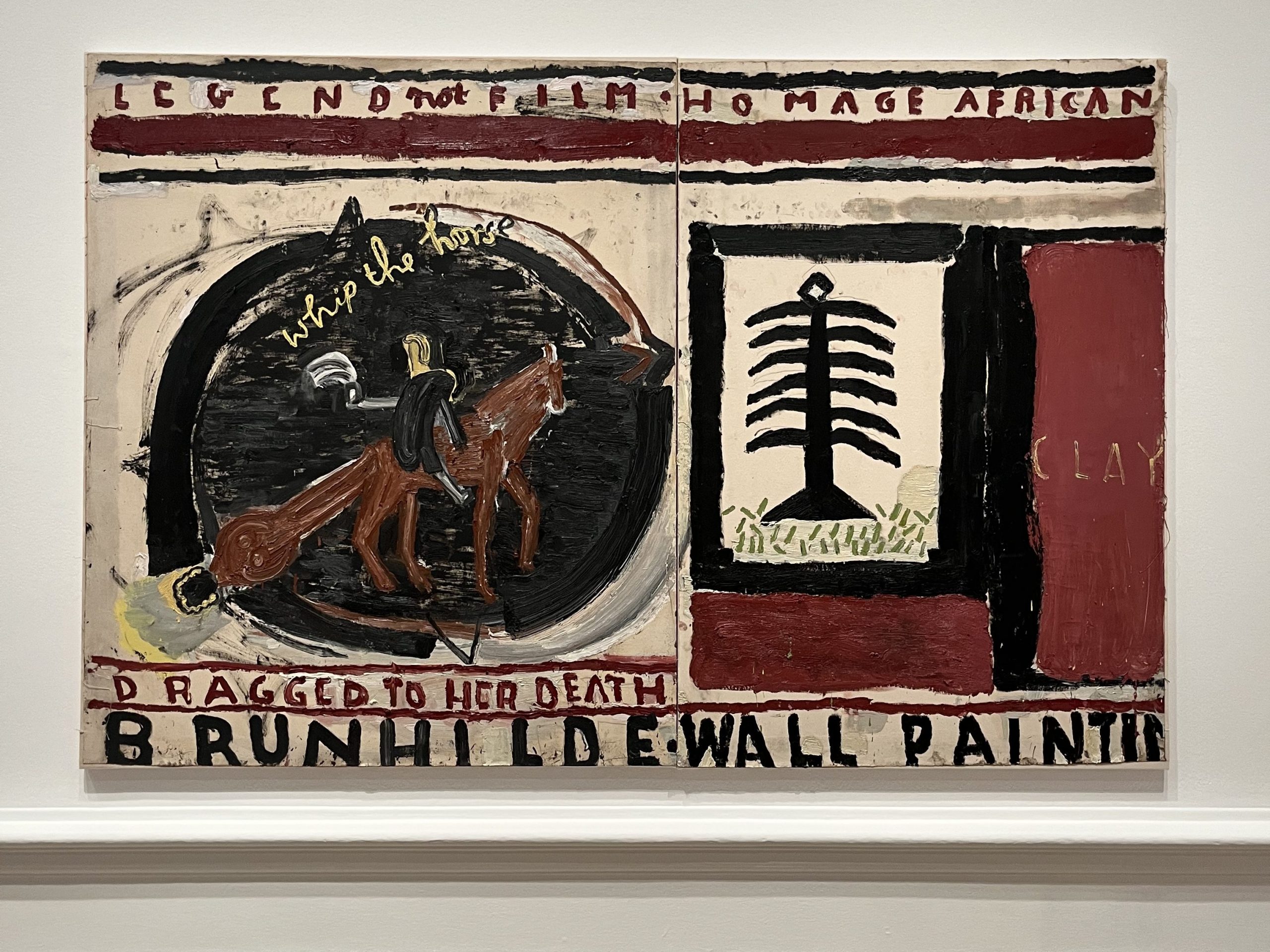
It is within this gap—between what a painting is and how it is received—that her use of colour becomes instructive. Perhaps brown can seem too familiar to register at first glance. It does not sit cleanly on the colour wheel and must be mixed; a product of shifting tones. Often the consequence of a day’s work, emerging from the intermixing of colours on a palette, it carries a sense of inevitability. Combined with its prevalence in the natural world, iron oxides being the most common in earth pigments, it risks being passed over too quickly.
Wylie’s paintings refuse to simplify. Across the exhibition, what is missed is not the work, but the attention it requires. In this, her practice makes no concessions—not to subject, nor to taste, nor to the speed at which a painting is expected to explain itself. She is, as the Royal Academy has billed her, “the rebel painter of the British art world.”
For more information visit the Royal Academy website
All Images via Art Observed.
– J. Gataaura
Pages: 1 2