AO Newslink
Monday, June 11th, 2012Vincent Gallo, against releasing his film, “Promises Written in Water,” leaves the Whitney Biennial without response.

Vincent Gallo, against releasing his film, “Promises Written in Water,” leaves the Whitney Biennial without response.
Harmony Korine, Still from Caput (2011). All images courtesy of Megan Hoetger for Art Observed.
Hosted by the Museum of Contemporary Art but housed at an off-site location, James Franco’s current exhibition, Rebel, has garnered a lot of attention in Los Angeles for its play on the artist/actor’s own celebrity status. Bringing together Franco’s contemporary fame with Nicholas Ray’s masterpiece Rebel Without A Cause (1955), the exhibition explores the contours of a life lived in Hollywood.
James Franco, “Rebel” Installation View (2012) featuring Ed Ruscha’s Rebel (2011).
The Telegraph interviews Turner Prize Winner, Grayson Perry, now showcasing his series for Channel 4. “I wanted the programme to be non-judgmental because I didn’t want my taste to dominate. It’s not about what is good and bad,” says Perry on the role of ‘taste’ in his new work.
Kiki Smith, “Catching Shadows” Installation view, Galerie Lelong, Paris. Photos for Art Observed by Thisbe Gensler.
“Kiki Smith: Chasing Shadows,” now on view at the Galerie Lelong in Paris through June 30, showcases Smith’s recent work addressing themes of vision and sight across a diverse range of media. Featuring prints, photography and sculpture, this group of works continues her ongoing examination of the human body and experience—prominent throughout her vast oeuvre. Her long engagement with anatomical systems, as metaphors for social and cultural orders, extends to this salient organ—the eye, conjuring both biological and metaphysical associations though graphic and sculptural representation. Smith celebrates the body as our fundamental means of experiencing the world through her clinical descriptions of the corporeal subject. In this fourth solo show at Galerie Lelong, Smith engages natural and conceptual modes of perception through the elemental theme of vision.
‬CNN depicts the life and achievements of the late Clyfford Still, “The most influential artist you’ve probably never heard of”, whose work is currently on display at an eponymous Denver museum.
(all photos courtesy of Regan Projects, Los Angeles, photography by Brian Forrest)
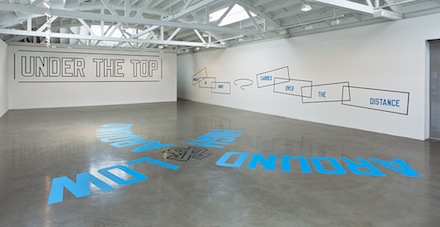
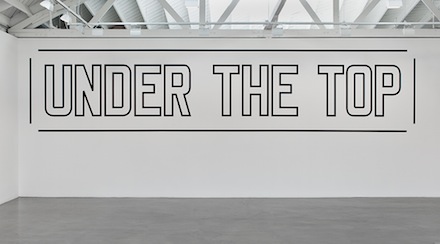
In his first exhibition in Los Angeles since his 2008 retrospective at the Museum of Contemporary Art, Conceptual art pioneer Lawrence Weiner took over the White Cube Gallery space at Regen Projects with his well-known works in language.
“1.THE ARTIST MAY CONSTRUCT THE WORK
2.THE WORK MAY BE FABRICATED
3.THE WORK NEED NOT BE BUILT”
From these three declarations, written in Weiner’s 1968 “Statement of Intent,” the artist not only moved from an object-based to a language-based practice, but helped to change the course of art production. A key member of the Conceptual art movement, which sought to examine the role of artistic intention in the production of meaning, Weiner eliminated the structural support of the frame in order to consider the larger contexts of the work. Since the late 1960s he has to this end triangulated language, architecture, and social-spatial orientation in an on-going exploration of how words perform meaning in space.
‬Larry Gagosian plans his 12th gallery worldwide and second in the Paris area, to be designed by French architect Jean Nouvel. “All the artists I talked to are very enthusiastic about it. It’s only about 20 minutes from the heart of the city,” says Mr. Gagosian.
Eugene Batz, “The Spatial Effects of Colors and Forms” from Kandinsky’s course (1929)
Bauhaus: Art as Life, on view at the Barbican Art Gallery in London, seeks to showcase not only the exceeding wealth of artistic production from this legendary school, but moreover to engage inspection of the cultural climate within which the foundation of modern design blossomed. The comprehensive collection of over 400 works, mined largely from the Bauhaus-Archiv Berlin / Museum für Gestaltung, Stiftung Bauhaus Dessau and Klassik Stiftung Weimar, is the largest Bauhaus show in Britain in over 40 years, representing pieces from its radical founding in 1919 to its final closure in 1933, tracing the transitions in style, ideology and aesthetic through a chronological progression. The works featured include paintings, sculptures, photography, film, textiles, ceramics, theater and more—a diverse and expansive artistic output representing a period of high artistic innovation. From iconic Bauhaus master works to compositions by lesser known students, this exhibition encapsulates the notion of art as life, the inseparability of social community and artistic production, and the human experience of this artistic-social experiment. From furniture to puppetry, typography to photomontage, this diverse range of production signals the creative effluence from this beacon of modernism and avant-garde design in a show celebrating the playfulness of collaborative Bauhaus culture.
Dutch artist Bart Jansen transforms his own dead cat into artistic installation.
National Portrait Gallery in London purchases portrait of famous transvestite Chevalier d’Eon. “The painting sheds fascinating light on gender in history…[D’Eon] is a positive role model for modern LGBT audiences,” says Lucy Peltz, curator of 18th-century portraits.
Photos for Art Observed by Charles Shoener
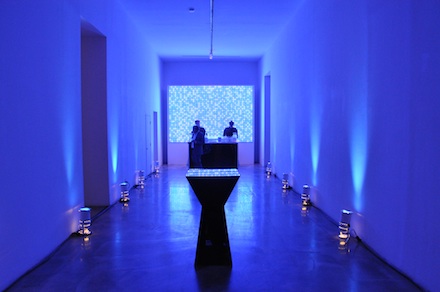
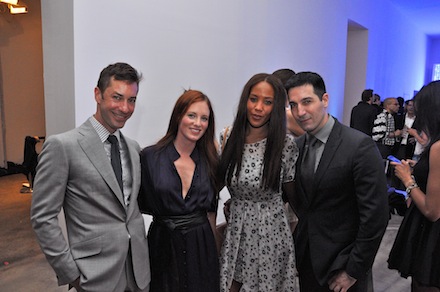
Every year, the Whitney Contemporaries, a group of young art patrons and enthusiasts, host a night of art, fashion, food, and entertainment on behalf of the Whitney Museum of American Art. Sponsored this year by fashion frontrunners Theory and Saks Fifth Avenue, the 2012 Whitney Art Party attracted the familiar well-dressed and named gathering. However, the true spotlight remained on the artists and live performances of the evening.
Committee Co-Chairs Bettina Prentice and Margaret Betts and Social Tom Dunn, with Mark Amadei, Owner of The Lion, one of the event’s restaurant caterers
Jill Magid, Still from The Capitol Shooter: Breaking News (2011).
In her first solo exhibition in Los Angeles, New York-based artist Jill Magid presents a dramatic-script-turned-multimedia-installtion in her Failed States. Drawing on the experimental narrative of her recent book (also titled Failed States), Magid inverts the oft-cited feminist phrase “the personal is political” to explore how the political might be made personal, or, how that which seems far away might be brought closer to our bodies and our experiences.
Jill Magid, Failed States installation view (2012). All images courtesy of Megan Hoetger for Art Observed.
‬The dates of the showing of Christian Marclay’s “The Clock” in New York are released. The overwhelmingly popular mash-up video work will screen for free at the Lincoln Center’s David Rubenstein Atrium on Broadway from July 13 to August 1.
The Guardian, by looking into Vyner Street galleries, examines macro factors causing East End of London galleries to move West, “The East End has only really flourished during a boom…in 2005 it felt like a critical hub. As the galleries I really admired moved out, collectors came less and less,” says Fred Mann, owner of Fred Ltd, one of the latest galleries to move West.
‬Lehmann Maupin Gallery to open Hong Kong location, deeming it “more positioned as a destination” than other Asian cities. “…We recognize there is an opportunity for the promotion of our artists’ work…[and] to contribute to the growth of Hong Kong’s gallery infrastructure,” say founders Rachel Lehmann and David Maupin.
‬Andrea Rosen Gallery to expand on 24th Street, Chelsea to a new venue named Gallery 2. “We’ll begin in September with an artist whom I can’t name just yet. It will be the artist’s first solo show in New York,” says Rosen.
‬Photographer Nan Goldin awarded the Edward MacDowell Medal for lifetime achievement in the arts. As Luc Sante chairman of the selection committee remarks, Goldin created a medium “halfway between still photography and cinema.”
Storied art dealer Michael Werner has donated a collection of 130 works to the Musée d’Art Moderne in Paris. “[His] gift represents the most significant enrichment…since the bequest made by Dr Maurice Girardin in 1953, which led to the creation of the Institution,” says Fabrice Hergott, gallery director.
Anish Kapoor, Untitled (2012) installation view, Gladstone Gallery, West 21st Street. All photos on site for Art Observed by Perrin Lathrop.
Anish Kapoor’s current solo exhibition at Gladstone Gallery confronts visitors with two opposing sides to the artist’s three decade long investigation into the nature of objectness. A veritable global art star, with a Venice Biennale Pavilion (1990), a Turner Prize (1991) and countless prestigious public art commissions under his belt, Kapoor is known for his perception bending works that verge on spectacle. In the Indian-born, London-based artist’s first show in New York in four years his new works expand across two gallery spaces on West 24th and 21st Streets. As an artist interested in the metaphysical polarities inherent in individual objects, Kapoor invests these two galleries with both organic and highly engineered approaches to the materiality of form.
Anish Kapoor, installation view, Gladstone Gallery, West 24th Street.
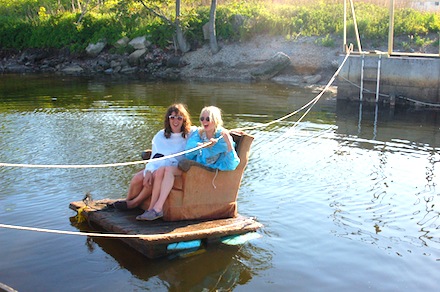
The chair-raft. All photos on site for Art Observed by Samuel Sveen.
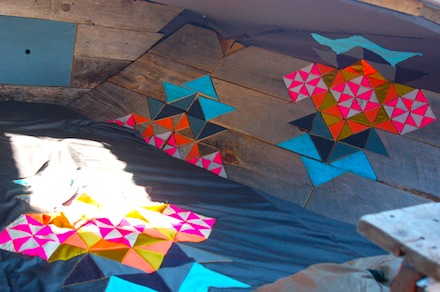
16 reclaimed boats make up the second summer of the Boggsville Boatel at Marina 59, an artful floating hotel in the Far Rockaways about an hour outside of Manhattan. Constance Hockaday created the project last year with the help of Flux Factory, taking a bit of loose inspiration from the 19th century floating brothel of Nancy Boggs outside of Portland, Oregon. This year Angie Kang and Orien McNeill organized 23 artists to convert an additional fleet of abandoned boats into accommodating art spaces. The artists were able to live on the boats for a two month residency, reconstructing and customizing the boats, building a community on the docks. Encouraged to be ‘adventure ready’—the suggested packing list includes sleeping bags and liquor—Art Observed was on site for the opening night, May 19.
‬Lindsay Lohan stars in Richard Phillips’ new short film “First Point,” premiering at Art Basel next week. “Because of the actor and the popular culture dimensions…it will give people…a real sense of instability…Is it a film? Is it an art video? It refuses to announce itself as either,” says Phillips.
Top collector Dakis Joannou’s DESTE foundation debuts its “destefashioncollection” exhibition in the window displays at Barneys New York. “We have incredible customers who come from the art world…that’s a big part of our customer base. To have that communication…is part of our uniqueness,” says Barneys CEO Mark Lee.
‬The Tate has revealed its 2013 program, which will include exhibitions of LS Lowry at Tate Britain, Marc Chagall in Liverpool, and a major Roy Lichtenstein at retrospective at The Tate Modern as well as shows of Gary Hume and Paul Klee.
A self-portrait by the late Jean-Michel Basquiat is expected to fetch $20 million in the June 27 Christie’s International sale of postwar and contemporary art in London. “The vivid acrylic, oilstick and spray-paint canvas will be offered after another untitled 1981 work sold for an artist-record $16.3 million at Phillips de Pury & Co. in New York, on May 10.”