Thursday, November 3rd, 2011
‪
The Guardian calls Eva and Adele (as it did Gilbert & George) “living artwork;” art pair tells the newspaper, “We invented our own sex.” [AO Newslink]


‪
The Guardian calls Eva and Adele (as it did Gilbert & George) “living artwork;” art pair tells the newspaper, “We invented our own sex.” [AO Newslink]
Gustav Klimt, Litzlberg am Attersee, 1914-15 (est. in excess of $25 million, realized $40.4 million) via Sothebys.com
The Impressionist and Modern art evening auction at Sotheby’s New York on Wednesday night realized $200 million for 57 of 70 lots sold. Business proceeded as usual within the auction house despite the deafening cacophony from protesters stationed outside the building’s main entrance (Sotheby’s has been feuding with their art handlers for months). Earlier today the auction house announced that one of the evening’s top lots – one of Matisse‘s bronze Nu De Dos sculptures estimated to bring $20-30 million- had been withdrawn from the sale after having been sold privately yesterday afternoon (along with the other three in the series, which also belonged to the Burnett Foundation, and which were slated to sell at auction over the next year). Excluding the Matisse, the sale carried estimates of $168-230 million. The $200 million total fell comfortably within expectations and bested Christie’s comparable sale on Tuesday evening. At the press conference Sotheby’s noted that last night’s results at Christie’s were “sobering” and that they did take the opportunity today to talk to consignors and in some cases lower reserves.
Antony Gormley, Still Standing (2011-12). Installation view. Via AntonyGormley.com.
British sculptor Antony Gormley has been given the opportunity to place seventeen new works in the Dionysius Hall of the classical Greek and Roman galleries of the Hermitage Museum in St. Petersburg, Russia. The exhibition is titled Still Standing: A Contemporary Intervention in the Classical Collection; the unique juxtaposition of contemporary sculpture in a classical setting sheds new light on the Hermitage Museum.
More text and images after the jump… (more…)
–>
Max Ernst, The Stolen Mirror, 1941 (est. $4-6 million, realized $16.3 million), via Christies.com
Christie’s evening sale of Impressionist and Modern art on Tuesday night brought in $140 million against presale estimates of $210-300 million. Four of the top 5 most valuable lots failed to sell, including the auction’s cover lot – a Degas ballerina sculpture with a presale estimate of $25-35 million. The Degas had been shopped around privately with no luck and carried what many believed to be a very aggressive estimate. The auction house cited those two facts to explain that lot’s failure, as well as the overall performance of the sale. In general, fresh to market material faired best, and hefty presale estimates deterred bidding on the priciest works. What turned out to be the evening’s top lot – Max Ernest‘s The Stolen Mirror – was both fresh to market and carried an estimate in line with the artist’s records and with heightened interest in Surrealist material over the past few auction cycles. The canvas set the record for the artist at auction when it sold for $16.3 million against a high estimate of $6 million. The previous record was set this past June at Christie’s London with a 1923 work that brought $4.4 million.
‪‬W Magazine posits Detroit as Berlin. Struggling economy allows cheap spaces for creatives [AO Newslink]
‪‬Cooper Union President Bharucha discusses possibility of charging tuition again after over a century, “We have to do the hard thinking now,” while alumni claim it to be a contradiction to the “DNA of the school” [AO Newslink]
Aleksandra Mir, The Seduction of Galileo Galilei, video still (2011). All images courtesy the artist and Mercer Union, Toronto.
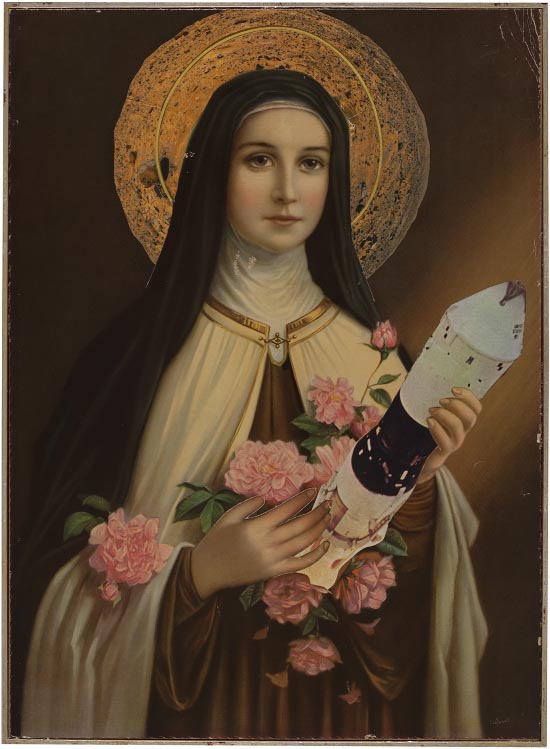
The second showing of The Seduction of Galileo Galilei, a video documenting Aleksandra Mir’s experiment with gravity and car tires stacked unnervingly high, is coupled with The Dream and The Promise, another previous series that combines religious iconography with elemental, scientific scenes. In her interview with AO, she explains how her inspiration largely lies between the crossover of the two—science and faith—so much so that each loses opposition, and within time are indistinguishable from one another.