Crossing Cultures: Shaping Albion Jeune’s Global Vision
Saturday, October 12th, 2024An interview with Lucca Hue-Williams on curating boundary-pushing art, global narratives, and the future of London’s creative landscape


An interview with Lucca Hue-Williams on curating boundary-pushing art, global narratives, and the future of London’s creative landscape
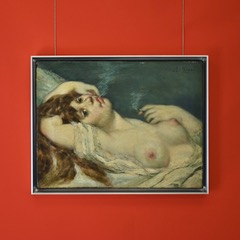
Armand Doré, Nude, Smoking and Reclining (c. 1860-65)
The French Exit group show brought to life by the curatorial eye of Mattias Vendelmans invites a dialogue between artists and their muses, considering just what happens when one skips the farewell in search of something more enticing after dark. How does the basic notion of privacy and vulnerability continue to pique our curiosity? Spanning works from oil paintings and sculptures to pen and paper, from Baudelairean Paris to the suburbs of 1930s Stockholm, an ongoing exploration of organic tenderness and bestiality in human nature unfolds.
The Guardian profiles painter Rachel Howard this week, Damien Hirst’s first assistant and spot painter, who is stepping into the spotlight on her own this year with her first UK public gallery solo exhibition. “We were mates and he needed someone to paint spots, and I was waitressing and I didn’t want a proper job – so I ended up working for him to earn enough money to make my own work,” Howard says. “It was a very good symbiotic relationship.” (more…)
The New Yorker’s Peter Schjeldahl offers his take on the “fearful frenzy” of the art market this week, and the ominous notes that the current focus on the market by the über-wealthy strike. “Alongside global prosperity has come a lot more political instability, and it’s in the interests of the social elite to keep their options open as to where they relocate,” he quotes from Artnet’s J.J. Charlesworth. (more…)
Collector and former MoMA President Agnes Gund is profiled in the Wall Street Journal this week, discussing the state of the market, her focus on female artists, and her organization Studio in a School, an arts program offering training in teaching art to young students. “If it’s taught well, art really is important to kids early on,” she says. “It helps children develop language and allows them to see themselves in a way that isn’t right or wrong, because if they draw an animal with five legs instead of four, nobody’s criticizing them for it.” (more…)
Artist Marc Quinn is interviewed in the Telegraph this week, as he prepares to show new work at White Cube this month. “I’ve always loved beaches,” he says, noting the connections between the ocean’s form and landscape and his own work. “I love that we come from the sea. I think that’s where my interest in liquid and solid comes from. The beach is where liquid and solid meet, so it has this incredible sense of possibility.” (more…)
Art Daily has an interview with Art Recovery Group’s founder Christopher Marinello, whose work investigating claims of Nazi-looted art and stolen works has made him a trusted authority on reclaiming lost art. “This is one of our specialities,” Marinello says of his recent case returning a stolen Rodin to a Los Angeles family. “Getting in the middle of a case and finding a way to twist everybody’s arm to settle the case.” (more…)
Mona Hatoum is profiled in The New York Times this week, as the artist prepares for her solo exhibition at the Centre Pompidou this month, and reviews the multi-faceted international upbringing that informs much of her work. “The basis of it is a feeling of wanting to be free of all those restrictions, whether it’s social or political, that are always put on people,” she says, “so I can be whatever I want to be.” (more…)
Jeff Koons is interviewed in The Guardian this week, as the artist prepares to open his traveling retrospective at the Guggenheim Bilbao this month, and his views on critiques of his work as trophies for multi-millionaires. “It happens to everybody – the work is held by someone who doesn’t even particularly enjoy the work, and just has it stored in some warehouse and will sit there for 20 years,” he says. “Or someone doesn’t understand it physically, and their motivations are just to show that they have the power to purchase. There’s not much you can do; that’s about educating people, and the way you can educate them is through your art. And I try to educate people about materialism through my work. I try to show them real visual luxury.” (more…)
John Waters is the subject of a profile in The Guardian this week, as the filmmaker-turned-artist prepares to open a show of his work in London, and discussing his aims towards his most recent body of work. “I wanted to be the most despised person imaginable, like I was when I started. I built a career out of it. I wasn’t hated by the people I wanted to like my work – I was hated by the people it was bait for,” he says. (more…)
Damien Hirst is the subject of a lengthy profile in The Guardian this week, exploring his often overlooked role in curating and presenting the work of the YBA’s in their early years, and his soon to open London gallery. “I’ve always wanted a gallery like Saatchi, the original Boundary Road,” he says. (more…)
Doug Aitken is interviewed in the Financial Times this week, as he opens the newest edition of Station to Station at The Barbican in London. “Culture is the language that will bring us into the future,” Aitken says. “But at the same time it is being surrounded by this conservative, capitalist system, which makes it harder than ever for individuals who have voices to push them as far as they can go.” (more…)
Takashi Murakami is the subject of the most recent “Lunch with the FT” Interview this week, joining a writer from the newspaper for lunch at the Kaikai Kiki Co. studios outside Tokyo, and discussing his role in a generation of artists investigating capitalism and its intertwined relationship with fine art, including his relationship to otaku subcultures. “People say, ‘Oh, Takashi steals from our culture.’ But wait a minute. Our culture means my culture, too, right?” (more…)
The Art Newspaper profiles the work of Zlot Buell, the art consulting firm that has earned a reputation for discretely advising tech entrepreneurs and Silicon Valley wealth in the contemporary art market, and notes the commonly assumed myth that tech collectors are interested in digital art. “They look at a screen all day long; they don’t need to look at another,” Ms Zlot says. (more…)
The Art Newspaper sits down with Guggenheim Director Richard Armstrong to discuss a range of issues with the Guggenheim’s ongoing expansion plans in Finland and Abu Dhabi, including pressures to improve labor conditions through the sub-contractors working on the project. “These are all questions that come under sovereignty; I feel unequipped to answer them,” Armstrong says. “I can state our position: we are in constant dialogue with TDIC and other intergovernmental agencies. It really is top of my mind.” (more…)
Jake and Dinos Chapman are profiled in The Guardian this week, discussing their sprawling Hell installation, and the countless horrors occurring across its expanse of miniature figures, and the first draft of the work’s destruction in a massive warehouse fire. “We heard the Momart warehouse was on fire and drove up to have a giggle because we thought it was full of other YBA art. Then we got a call saying Hell was in there,” Jake Chapman says. “We just laughed: two years to make, two minutes to burn. A smart-assed journo phoned up and said: ‘Is it true that Hell is on fire?’ It was fantastic – like a work of art still in the process of being made, even as it burnt.” (more…)
The Guardian notes the recent completion of two new European contemporary art spaces (The Garage Center in Moscow and the Fondazione Prada in Milan) designed by Rem Koolhaas, heralding what some consider a new era in the shape and strategy for cultural centers. “If you want to change the world you also have to decide what you want to keep,” Koolhaas states.
Painter Zeng Fanzhi is the subject of a video profile on Nowness this week, shot in Paris and exploring his work and stance towards creating. “An artist should follow his heart, create, then keep moving,” he says. “If you keep repeating yourself than that’s a waste of the artistic life.” (more…)
W Magazine takes a look inside the home of Frieze director Victoria Siddall and her partner, gallerist François Chantala this week, just in time for the opening of the organization’s New York edition. “Our work and social lives are totally continuous and intertwined,”Siddall says. “But when we’re in the same city, it means that at least we get to see each other in the evenings. The art lot always knows how to put on a great party.” (more…)
The New York Times visits Michael Heizer at his Nevada ranch and studio, and explores his ongoing project City. “It epitomizes a fusion of ancient and modern forms,” Heizer says. “It’s huge in size, but antimonumental in its relentless horizontality and its sinuous, continuous curves. It’s also unphotographable and impossible to capture in its totality. It has to be experienced in time and space — over time, and distance.” (more…)
The endlessly prolific Hans Ulrich Obrist has a new book out this week, titled Lives of the Artists, Lives of the Architects, tracing a series of the artist’s ongoing conversations with artists and designers over the course of his career, including pieces with David Hockney and Marina Abramovic. (more…)
Cecily Brown is profiled in New York Magazine this week, as the artist opens an exhibition of new work at Maccarone Gallery in the West Village, smaller works that mark a shift in her career after ending her relationship with Gagosian Gallery. “People would see them and say, ‘Are they studies for the big ones?’” Brown says. “I joked that the big ones had become studies for the small ones. The big ones seemed very fast and loose, and the small ones were very neurotic. There was a while I called them ‘The Neurotic Paintings.’ They were so intense, very painterly, the paint got thicker. You have to believe the viewer has a more intimate relationship because you have to get up close.” (more…)
David Hockney is the subject of an interview in The Guardian this week, revisiting his life among movie stars and artists during the 1960’s, contrasted with his intense work ethic. “I thought I was a hedonist at the time, but when I look back I was always working,” he says. “I am always working. I work every day. I never give parties; I never gave them.” (more…)
The New York Times takes a look at the work of Chuck Close this week, as the artist prepares to open a major retrospective at the Parrish Art Museum, examining his use of exacting photographic techniques and his approach to painting. “I approach all subjects the same,” Close says. “Of course I can’t collaborate with a flower the same way I can with a human, but there is an inherent sensuality in a flower that relates to the nudes, and the close-up details of the flowers are equally revelatory.” (more…)